

• Link to Facebook
  • Link to X
  • Link to Youtube
  • Link to Instagram
  • Link to LinkedIn
  • Link to Rss this site
  • Store
  • Donate
  • About
        • About Us

        • Cancer Nation is the oldest cancer survivor-led non-profit organization in America. We advocate for quality cancer care for all touched by cancer.

        • About NCCS

        • Our Mission
        • What is Advocacy?Learn about the different types of cancer advocacy, from personal advocacy to public interest advocacy.
        • Our HistoryRead how Cancer Nation’s leaders coined the term “cancer survivor,” and established the nation’s first survivor-led non-profit organization.
        • Our Team
        • Financial Information
        • Employment
        • Contact Us
        • Support Our Mission

        • Make A GiftSupport our mission of quality cancer care for all with a gift to Cancer Nation.
        • The 1986 ClubMake a monthly commitment to support Cancer Nation, empower cancer survivors, and advance public policy.
        • Ways to GiveLearn about other ways you can contribute to Cancer Nation such as planned giving, employer matches, shopping online, and more.
        • Partnerships
  • News
    • Cancer Nation News
    • Advocate SpotlightEach month, Cancer Nation highlights a cancer survivorship advocate, sharing their story and the work they do in their communities.
    • Policy CommentsRead Cancer Nation’s comments to Congress, HHS, and other federal policymakers in Washington, DC on proposed rules and legislation.
    • Issue StatementsRead Cancer Nation statements on pressing issues and developments in Washington affecting cancer survivors and their families.
  • Policy
        • Policy

        • Public policy is government action, in the form of legislation, regulation, funding, and other actions. Public policy affects people with cancer and the cancer care system in many ways.

        • Our Policy Priorities

        • Quality Cancer CareQuality cancer care is essential for patients. Learn how Cancer Nation and others define quality.
        • Access to CareCancer Nation believes cancer care and clinical trials should be affordable and accessible to everyone.
        • Health EquityThe cancer experience is not the same for everyone. Cancer Nation works on policy efforts to reduce disparities in outcomes.
        • Current Issues

        • Protecting Access to Medicaid for Cancer Survivors
        • Comprehensive Cancer Survivorship Act (CCSA)The CCSA is a large comprehensive bill introduced in Congress that aims to improve quality of care in all stages of a diagnosis.
        • Cancer Care Planning and Communications Act (CCPCA)CCPCA is a bill that would provide a billable Medicare service code for cancer care planning.
        • DIEP Flap AccessCancer Nation advocates for protection of access to DIEP Flap Breast Reconstruction Surgery for all breast cancer survivors.
        • Policy CommentsRead Cancer Nation’s comments to Congress, HHS, and other federal policymakers in Washington, DC on proposed rules and legislation.
        • Issue StatementsRead Cancer Nation statements on pressing issues and developments in Washington affecting cancer survivors and their families.
        • Quality Measurement Research
  • Get Involved
        • Get Involved

        • Whether you’re new to cancer advocacy or already have experience as an advocate, there are numerous ways you can get involved with Cancer Nation.

        • Join Cancer Nation

        • Cancer Nation AdvocatesA program that brings together individuals who care about cancer care to learn how policy shapes our health care system—and how we can improve it together.
        • Cancer Nation Leadership AcademyEmerging leaders improving cancer care in their communities.
        • Cancer Nation Corporate Council
        • Advocacy OpportunitiesThis page provides a list of upcoming events, webinars, conferences, and advocacy campaigns from Cancer Nation and other leading cancer organizations.
        • Connect with Us

        • Subscribe to Cancer Nation Updates
        • Follow Cancer Nation on Social Media
        • Survivor Stories
        • Cancerversary
        • Support Cancer Nation

        • Make A Gift
        • Ways to Give
        • The 1986 Club
  • Survivorship Survey
        • State of Survivorship Survey

        • Cancer Nation conducts an annual State of Survivorship Survey, in partnership with Edge Research, to explore the cancer patient and survivor journey. This study captures a range of perspectives to better understand how Cancer Nation can support its mission to advocate for quality cancer care for all.

        • Reports by Year

        • 2025 Survey Report
        • 2024 Survey Report
        • 2023 Survey ReportThe 2023 Survey explored the caregiver experience for the first time, and features new data on the effect of cancer treatment on employment.
        • 2022 Survey ReportThe 2022 Survey found significant disparities in cancer care that impact people of color, young adults, women, and those with metastatic cancer, at higher rates.
        • 2021 Survey ReportThe 2021 Survey demonstrated that when patients receive quality care, have excellent support, and have financial resources, they are more likely to have positive outcomes.
        • 2020 Survey ReportIn the 2020 Survey, survivors reported that their care team is not helpful at addressing some common side effects of their cancer such as fatigue, anxiety, and depression.
  • Survivorship Checklist
        • Cancer Survivorship Checklist

        • The Cancer Survivorship Checklist is designed to be a simple, straightforward tool patients and caregivers can use as a guide for information critical to their care wherever they are on the cancer care continuum.

        • Start Your Cancer Survivorship Checklist
        • Survivorship Checklist Guide for Clinicians
        • Resources for Cancer Survivors

        • Survivorship ResourcesA collection of resources that provide information about navigating the cancer journey.
        • Cancer RehabilitationA supportive health care service that helps improve a person’s functioning during and after cancer treatment.
        • Integrative OncologyA field that combines traditional cancer treatments with therapies that support a person’s natural healing ability.
        • Palliative CareSpecialized medical care for people living with a serious illness that provides relief from the symptoms and stress to improve their quality of life.
        • Cognitive HealingA resource to support cognitive functioning after cancer treatment. Includes cognitive training strategies and tools for both adults and children.
  • Resources
        • Resources

        • Cancer Nation provides a wide variety of resources for patients, caregivers, and health care professionals.

        • Resources for Survivors and Caregivers

        • Health Insurance & Open Enrollment
        • Cancer Survival ToolboxA free, award-winning audio program created by leading cancer organizations to help people better meet & understand the challenges of their illness.
        • Ina® The Intelligent Nutrition Assistant
        • Telehealth
        • Care Planning for Cancer Survivors
        • Remaining Hopeful
        • Self Advocacy
        • Talking With Your Doctor
        • Taking Charge of Your Care
        • Order Our Resources
        • Resources for Health Care Professionals

        • Tools For Care Providers
        • Telehealth Project
        • Survivorship Champions Webinars
        • Survivorship Checklist Guide for Clinicians
  • Events
    • 2026 Cancer Nation Summit
    • Igniting Hope Awards Reception
    • Ellen L. Stovall Award
      • 2025 Winners
      • Awardees
      • Nominations
      • Committees
    • Cancer Nation Webinars
    • Cancer Nation Policy Roundtable
      • Fall 2025
      • Spring 2025
      • Fall 2024
      • Spring 2024
      • Fall 2023
      • Spring 2023
  • 0

NCCS is now Cancer Nation. Find out more about our next chapter.    Join Us

20years

Cancer Survivorship: You’re Never Really Done
July 28, 2015/in Cancer News, Cancer Policy Blog Care Planning, Quality Cancer Care, Survivorship Care Cancer Nation News
Ellen Stovall

Post By Ellen Stovall, Senior Health Policy Advisor and 42-Year Survivor

When the Imperatives of Quality Cancer Care were written by NCCS 20 years ago, one principle of quality care stated that, “Long-term survivors should have access to specialized follow-up clinics that focus on health promotion, disease prevention, rehabilitation, and identification of physiologic and psychological problems. Communication with the primary care physician must be maintained.”

It was NCCS’s vision two decades ago that there would be enough evidence to support access to and insurance coverage for interventions for short and long-term survivors related to promoting health, preventing disease, and both physical and psychosocial rehabilitation. In 2015, we are happily closer to realizing some parts of that vision, but far from able to implement it across all populations and inclusive of all settings where post-treatment cancer care is offered.

Like most of us treated for cancer, being finished with treatment is simply another stage of what we call survivorship—the act of living with, through, and beyond the diagnosis. In fact, cancer survivorship from diagnosis through the end of life has its own roadmaps fraught with much uncertainty. Each of the more than 14 million cancer survivors among us has their own story of survivorship.

“What most people diagnosed with cancer want is to be cured; what few oncologists and their patients understand or even want to discuss are the consequences of those treatments and how they should be managed.”

As a 24 year-old wife and mother to our four-week old son, Jonathan (he is now 43), I was diagnosed with Hodgkin’s Lymphoma in 1971. Following surgery and six months of radiation, a recurrence of the same diagnosis appeared 12 years later followed by a diagnosis of bilateral breast cancer seven years ago, resulting in a double mastectomy. Those are my cancer diagnoses. And then there comes daily living with a heart, lungs, kidneys, bones and tissues that look and feel like those of someone 20 years older than my chronological years. These clinical and psychological adjustments that most of us survivors experience are little discussed.

What most people diagnosed with cancer want is to be cured; what few oncologists and their patients understand or even want to discuss are the consequences of those treatments and how they should be managed. This is the world of cancer survivorship, and that population of survivors grows exponentially every day. Knowing there are short and long-term consequences of those treatments is part of the planning for survivorship that must begin at diagnosis. Choosing treatments with fewer long-term effects or intervening to prevent some of those effects is also needed.

I am a privileged cancer survivor. I have access to a specialized follow-up clinic, but have been less successful in having my many specialists communicate with one another to determine the best surveillance and course of ongoing interventions that may be needed. Consequently, I remain one of many survivors who are captive to a healthcare system where duplicate tests are ordered and there is little, if any, coordination of care among my physicians. And so I created my own plan for follow-up care, which at the time of my diagnosis was limited to clinical guidelines that said I should have CT scans and bloodwork every 3 months; then 6 months; and then yearly “for the rest of my life.” Just what I needed—more radiation exposure—but in fact, these procedures were defined as “appropriate follow-up care.”

As it turns out, my first recurrence with Hodgkin’s Lymphoma was diagnosed after I had symptoms that I instinctively knew were reminiscent of how I felt when I was first diagnosed. I had a hard time convincing my oncologist that I was ill, and only after persistent nagging for him to do more tests was the recurrence discovered. This is not an uncommon story among my fellow survivors. It was at this time on my own path of post-treatment care that I began an earnest investigation into long-term survivorship care. There was not a lot to read about, with only a handful of researchers even interested in the topic.

I began to cobble together all of my medical records and to write my own care plan. I summarized everything that had happened to me in the 12 years since my original diagnosis onto one page and, along with a list of every medicine, etc., took this information to any new doctor who saw me. I requested that a new doctor “consult” with my oncologist before prescribing any new treatments. I expect I may have been described as a “challenging” or “difficult” patient, despite how polite I considered myself to be.

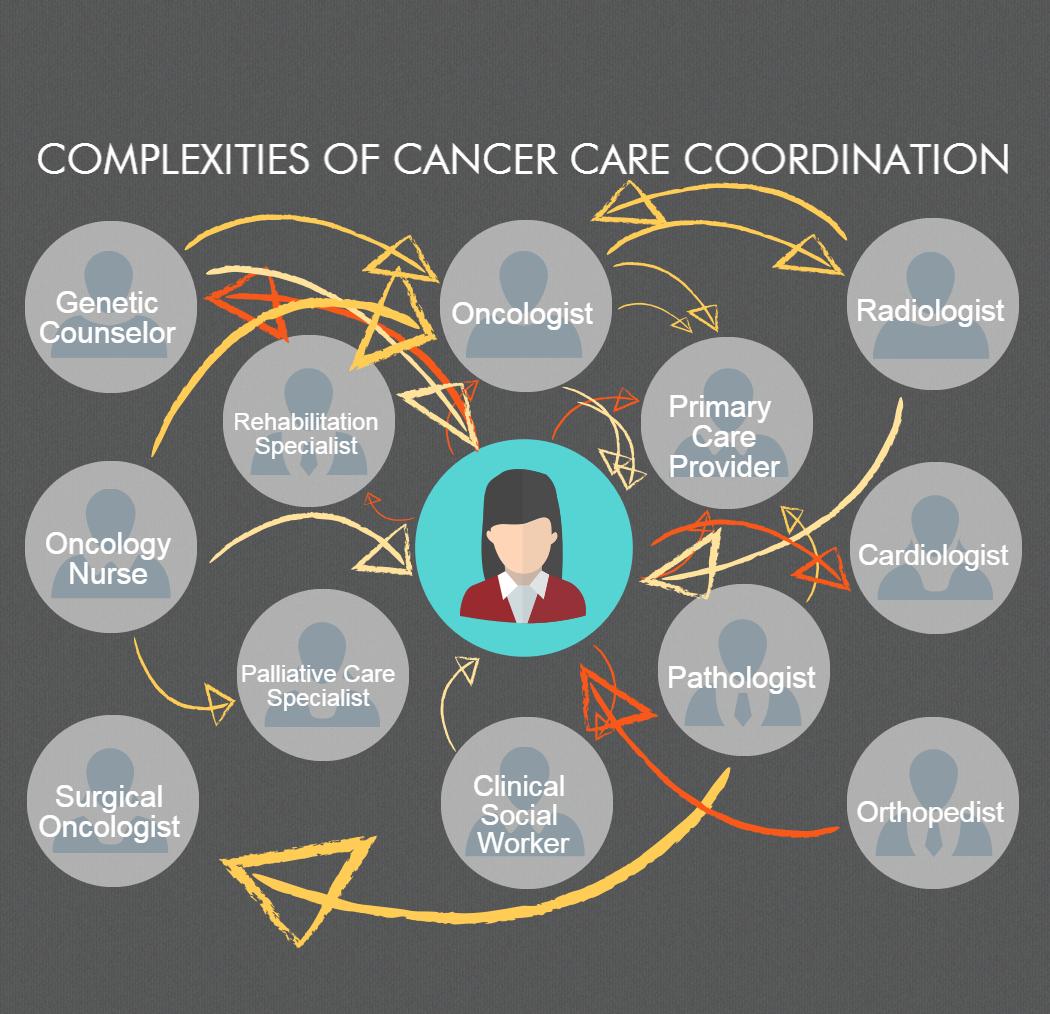
Over the years, advocacy on the part of many organizations has made follow-up care for cancer survivors, less of a “one-off” notion. The exercise of shared decision-making and care planning is being brought into discussions regarding new delivery and payment models for cancer care among physicians and third-party payers of healthcare. What follows is a graphic illustration of the care planning process. While we may not realize the full vision of follow-up clinics to deliver this care, we are beginning to see a systematic incorporation of some essential elements of best practices in the processes for making important decisions about our treatment options when we are first diagnosed. This will go a long way towards mitigating some of the late effects of cancer treatment.
care coordination complexities

This diagram illustrates the complexity of cancer care coordination. With clinical, procedural, and other supportive office visits, cancer patients may need to coordinate care with additional members of their care team, including a nurse navigator, a psychotherapist, occupational therapist, neurologist, hematologist, gynecologist, urologist, pulmonologist, or other providers. This diagram is adapted from “Ambulatory Care Coordination for One Patient” from Instant Replay — A Quarterback’s View of Care Coordination, a perspective piece by Matthew J. Press, M.D.


Read more posts from our 20 Years Later blog series »

Tags: 20 Years Later, by Ellen Stovall, cancer care, Cancer Survivorship, care planning, Ellen Stovall, patient first, quality
Share this entry
  • Share on Facebook
  • Share on X
  • Share on WhatsApp
  • Share on LinkedIn
https://canceradvocacy.org/wp-content/uploads/2015/01/20years.gif 500 500 actualizedevs https://canceradvocacy.org/wp-content/uploads/CancerNation_Logo_Stacked_TwoColor.svg actualizedevs2015-07-28 10:19:132015-07-28 10:19:13Cancer Survivorship: You’re Never Really Done

Latest News

A graphic showing the Medicaid.gov website

Cancer Nation Statement: Medicaid Work Requirements Will Unfairly Burden Cancer Survivors

June 4, 2026
Cancer Nation strongly supports a health care system free of waste, fraud, and abuse. Health care resources must be directed to delivery…
Read more
https://canceradvocacy.org/wp-content/uploads/Stock-Medicaid-website-Adobe-927192378.jpg 675 1200 NCCS Staff https://canceradvocacy.org/wp-content/uploads/CancerNation_Logo_Stacked_TwoColor.svg NCCS Staff2026-06-04 12:56:142026-06-05 13:42:09Cancer Nation Statement: Medicaid Work Requirements Will Unfairly Burden Cancer Survivors
Image with graphics and text that reads Cancer Nation Understanding Blood-Based Testing in Cancer Care | Watch Now | With Support From: Guardant Health Logo

Webinar – Understanding Blood-Based Testing in Cancer Care

May 29, 2026
Cancer Nation's Webinar Series presents a clear, practical conversation about advances in blood-based testing and how they're shaping…
Read more
https://canceradvocacy.org/wp-content/uploads/Blood-Based-Testing-Webinar-post.jpg 675 1200 NCCS Staff https://canceradvocacy.org/wp-content/uploads/CancerNation_Logo_Stacked_TwoColor.svg NCCS Staff2026-05-29 11:28:002026-05-29 11:28:00Webinar – Understanding Blood-Based Testing in Cancer Care
a picture of susie leigh similing wearing a purple top. Words over the photo read In loving memory, Susie Leigh, Cancer Nation Co-founder, 1947-2026

Remembering Susie Leigh: A Founder, a Force, and a Friend

May 28, 2026
Susan (Susie) Leigh, BSN, RN-Retired — one of the founding members of Cancer Nation, a five-time cancer survivor, and one of the…
Read more
https://canceradvocacy.org/wp-content/uploads/Susie-Leigh-In-Memory-blog.jpg 900 1600 NCCS Staff https://canceradvocacy.org/wp-content/uploads/CancerNation_Logo_Stacked_TwoColor.svg NCCS Staff2026-05-28 15:14:382026-06-04 14:32:40Remembering Susie Leigh: A Founder, a Force, and a Friend

Take Action

Link to: Survivorship Champions

Get Involved in Research

Cancer Nation conducts an annual Survivorship Survey to explore how patients and survivors are living with, through, and beyond cancer. This study captures a range of perspectives to better understand how Cancer Nation can support its mission to advocate for quality cancer care for all.

Learn More and Request Data Here »
Link to: Cancer Nation Advocates

Join Cancer Nation Advocates

Cancer Nation Advocates is a a program that brings together individuals who care about cancer care to learn how policy shapes our health care system—and how we can improve it together

Learn More and Join »
Link to: Survivor Stories

Share Your Story

Cancer Nation represents the millions of Americans who share a common experience – living with, through and beyond a cancer diagnosis. By sharing your story of how you have been touched by cancer, you are supporting the national cancer survivorship movement.

Share Your Story »
  • About
    • Our Mission
    • What is Advocacy?
    • Our History
    • Our Team
    • Financial Information
    • Employment
    • Contact Us
    • Make A Gift
    • The 1986 Club
    • Ways to Give
    • Partnerships
  • News
    • Cancer Nation News
    • Advocate Spotlight
    • Policy Comments
    • Issue Statements
  • Policy
    • Quality Cancer Care
    • Access to Care
    • Health Equity
    • Protecting Access to Medicaid for Cancer Survivors
    • Comprehensive Cancer Survivorship Act (CCSA)
    • Cancer Care Planning and Communications Act (CCPCA)
    • DIEP Flap Access
    • Policy Comments
    • Issue Statements
    • Quality Measurement Research
  • Get Involved
    • Cancer Nation Advocates
    • Cancer Nation Leadership Academy
    • Cancer Nation Corporate Council
    • Advocacy Opportunities
    • Subscribe to Cancer Nation Updates
    • Follow Cancer Nation on Social Media
    • Survivor Stories
    • Cancerversary
    • Make A Gift
    • The 1986 Club
    • Ways to Give
  • Survivorship Survey
    • 2025 Survey Report
    • 2024 Survey Report
    • 2023 Survey Report
    • 2022 Survey Report
    • 2021 Survey Report
    • 2020 Survey Report
  • Survivorship Checklist
    • Start Your Cancer Survivorship Checklist
    • Survivorship Resources
    • Cancer Rehabilitation
    • Integrative Oncology
    • Palliative Care
    • Cognitive Healing
    • Survivorship Checklist Guide for Clinicians
  • Resources
    • Cancer Survival Toolbox
    • Telehealth
    • Health Insurance & Open Enrollment
    • Care Planning for Cancer Survivors
    • Ina® The Intelligent Nutrition Assistant
    • Remaining Hopeful
    • Self Advocacy
    • Talking With Your Doctor
    • Taking Charge of Your Care
    • Order Our Resources
    • Tools For Care Providers
    • Telehealth Project
    • Survivorship Champions Webinars
    • Survivorship Checklist Guide for Clinicians
  • Events
    • 2026 Cancer Nation Summit
    • Igniting Hope Awards Reception
    • Ellen L. Stovall Award
      • 2025 Winners
      • Awardees
      • Nominations
      • Committees
    • Cancer Nation Webinars
    • Cancer Nation Policy Roundtable
      • Fall 2025
      • Spring 2025
      • Fall 2024
      • Spring 2024
      • Fall 2023
      • Spring 2023
  • Search
  • Cart

Charity Navigator Four-Star Rating

Cancer Nation Logo

Cancer Nation
8455 Colesville Road  |  Suite 1025 | Silver Spring, MD 20910
info@canceradvocacy.org | (877) NCCS-YES
Privacy Policy  |  Terms and Conditions

Copyright © 1995-2026 by Cancer Nation. National Coalition for Cancer Survivorship, NCCS, Cancer Survival Toolbox, Cancerversary, and related Logos are registered in the United States as trademarks of Cancer Nation (formerly the National Coalition for Cancer Survivorship).

Link to: Guest Video: Mary McCabe Discusses Survivorship Care Planning and the Delivery of Coordinated Care Link to: Guest Video: Mary McCabe Discusses Survivorship Care Planning and the Delivery of Coordinated Care Guest Video: Mary McCabe Discusses Survivorship Care Planning and the Delivery...20years Link to: Guest Post Series: Dr. John Cox Offers Physician’s Perspective on Oncology Care Model Link to: Guest Post Series: Dr. John Cox Offers Physician’s Perspective on Oncology Care Model Fotolia 73341760 SGuest Post Series: Dr. John Cox Offers Physician’s Perspective on Oncology...
Scroll to top Scroll to top Scroll to top

This website uses cookies to improve user experience. By continuing to use this site, you agree to our Privacy Policy. Learn More.

Get Updates From Cancer Nation

Be the first to hear about cancer policy and survivorship issues! Subscribe and receive the twice-monthly Cancer Nation News, invites to webinars and events, and more.

  • This field is for validation purposes and should be left unchanged.

Connect With Us

Twitter     Facebook     Instagram     LinkedIn     YouTube

Harmar Brereton, MD

Founder
Northeast Regional Cancer Institute


“Perhaps one of the most impactful collaborations in Dr. Brereton’s extraordinary career remains his early work and long friendship with Ellen Stovall. Through him, and in turn through the thousands of lives he has touched, Ellen’s work continues, and her mission lives on.”

—Karen M. Saunders
President, Northeast Regional Cancer Institute